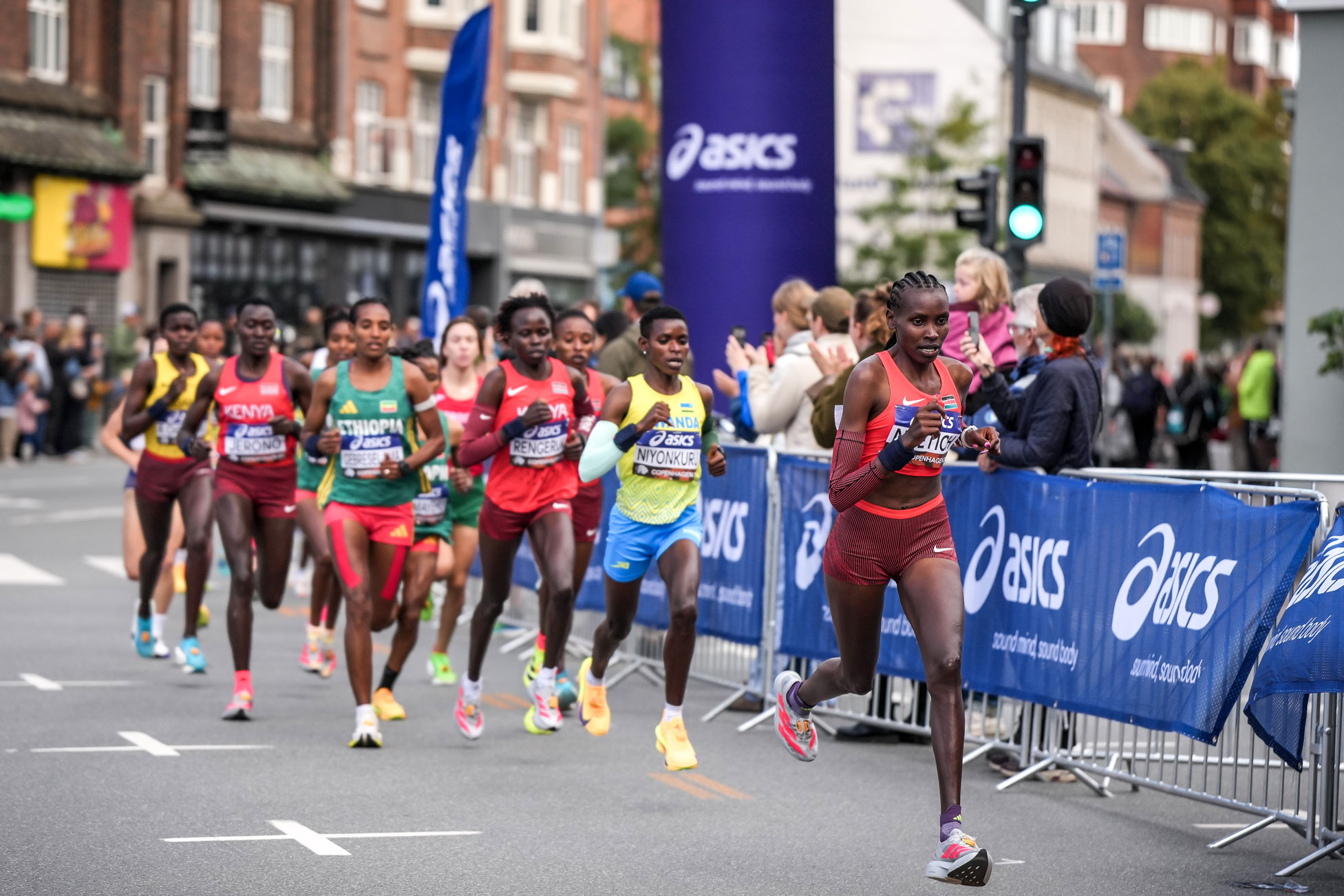
Agnes Jebet Ngetich decided the women’s half marathon in Copenhagen early. “After one kilometre, I was like, let me try to push the pace, because I saw an opportunity to get the world record,” she said afterwards.
She was right. On 20 September 2026 she finished in 1:05:15, one second inside the women-only world half marathon record that Peres Jepchirchir set when winning the 2020 World Half Marathon Championships in Gdynia. The record is subject to the usual ratification procedure. Veronica Loleo took silver for Kenya in 1:06:05, 50 seconds behind, and Daisilah Jerono was fourth in 1:06:13.
It was Ngetich’s second world title of 2026. In January she won the World Cross Country Championships in Tallahassee. Her season also includes a world-leading 28:58 for 10km in Lille and 8:08.95 for 3,000m in Monaco, so cross country, road and track have all produced a world-class result for her this year. She replaced as record holder the woman who had won the previous two world half marathon titles.
Copenhagen was a Kenyan team story too
Sixteen Kenyans started in Copenhagen, eight men and eight women, across the half marathon, the 5km and the road mile.
A team’s time in these races is the sum of its three best finishers, which is how Kenya’s men won the half marathon team title with a silver medallist, a fifth and an eighth. Nicholas Kipkorir Kimeli was second in 58:11, five seconds behind Sweden’s Andreas Almgren, who ran a European record of 58:06. Gideon Kipkertich Rono (58:57) and Alex Nzioka Matata (59:22) completed a team time of 2:56:30, 3 minutes 17 seconds ahead of Ethiopia. Daniel Ebenyo was ninth in 59:42 as Kenya’s fourth finisher. The women’s team of Ngetich, Loleo and Jerono won in 3:17:33, ahead of the United States and Ethiopia.
The first day had already brought medals. Caroline Makandi Gitonga took silver in the women’s 5km in 14:48, and Mirriam Cherop won bronze in the women’s road mile in 4:25.71, with Naomi Korir fifth. Both distances have a mixed team competition, scored from two men and two women, and Kenya finished third in each: 56:31 in the 5km and 16:51.36 in the mile.
When counted, that is five individual medals (one gold, three silver, one bronze) and four team medals (two gold, two bronze). World Athletics’ championship medal table lists Kenya first with seven medals: three gold, three silver and one bronze. Counting the two mixed-team bronze medals awarded in the 5km and road mile separately brings Kenya’s medal-winning performances in Copenhagen to nine: three gold, three silver and three bronze.
The championship Kenya has known since 1992
The championship Ngetich won is older than its name. It began as the World Half Marathon Championships in South Shields, England, in 1992, run alongside the Great North Run. The title changed for 2006, when the event became the IAAF World Road Running Championships and was run over 20km in Debrecen. The half marathon returned in 2007 in Udine, still under the road running name, and from 2008 it was again the World Half Marathon Championships, through Gdynia in 2020.
It was staged every year until 2010 and every second year afterwards. The 2023 edition in Riga introduced the present programme: the half marathon, a 5km and a road mile. San Diego was due to host in 2025, but World Athletics moved the event and then cancelled the 2025 edition, so no championships were held that year. Copenhagen, which also held the half marathon championships in 2014, staged the second edition of the current format to take place. The half marathon is not an Olympic event, nor part of the World Athletics Championships programme, so this is where its world titles are decided.
Kenya’s own record starts on the first day. Benson Masya won the men’s race in South Shields in 1:00:24, and Kenya won the men’s team title. Kenya has contested all 26 editions and won a medal at every one.
In all, 171 Kenyans have started a race, 102 men and 69 women, and 38 of them started at more than one edition. They have won 71 individual medals (25 gold, 24 silver and 22 bronze) and 43 team medals (30 gold, 10 silver and 3 bronze). Kenyan women hold 38 of the individual medals to the men’s 33, even though no Kenyan woman started at the first championship and only one started before 1997.
At a glance
Kenya at the World Road Running Championships
Every edition of the championship lineage that began with the World Half Marathon Championships in 1992. Individual and team medals are counted separately.
Editions contested
- Editions, 1992u20132026
- 26
- With a Kenyan medal
- 26
Kenyan starters
- Starts
- 232
- Different athletes
- 171
Individual medals
- Medals
- 71
- Gold / silver / bronze
- 25 / 24 / 22
Team medals
- Medals
- 43
- Gold / silver / bronze
- 30 / 10 / 3
Copenhagen 2026
- Individual medals
- 5
- Team medals
- 4
Figures from the Athletes of Kenya competition dataset, which records athletes who started, not those entered. The 2006 edition was run over 20km. Copenhagen 2026: individual medals 1 gold, 3 silver, 1 bronze; team medals 2 gold, 2 bronze.
The runners who built the record
That one woman was Tegla Loroupe. She took bronze in Brussels in 1993, then won Kenya’s first women’s title in Košice in 1997 in 1:08:14, and defended it in Uster in 1998 and Palermo in 1999. Her eight medals are split evenly: four individual (three gold and a bronze) and four in the team race (three gold and a silver).
Palermo gave Kenya two champions. A week after setting a marathon world best in Berlin, Loroupe won the women’s race by 24 seconds over Japan’s Mizuki Noguchi in 1:08:48. In the men’s race, Paul Tergat won by a stride from South Africa’s Hendrick Ramaala in 1:01:50. Catherine Ndereba took the women’s bronze, and Kenya’s women won the team title. It was the third year running that Kenya won both individual half marathon titles, after 1997 and 1998. It has happened four times since: 2010, 2014, 2016 and 2023.
Tergat won again in Veracruz in 2000 and, according to World Athletics, became the first man to successfully defend the title. His four world half marathon golds are two individual and two in the team race.
The team race explains some years the individual medals do not. Eritrea’s Zersenay Tadese won the men’s title four years running from 2006 to 2009. Kenya’s men won the team title in each of those years, and each time had a runner second behind him: Robert Kipkorir Kipchumba in 2006, Patrick Makau Musyoki in 2007 and 2008, and Bernard Kiprop Kipyego in 2009. Over the whole history Kenya’s men have medalled in the team race at 24 of 26 editions and won it at 18.
New Delhi in 2004 shows the same principle at its smallest scale. Paul Kiprop Kirui won in 1:02:15, 16 seconds clear of Tanzania’s Fabiano Joseph. Kenya started only three men, Kirui, John Korir and Wilson Kiprotich Kebenei, and their combined 3:07:55 took the team title back from Tanzania, who had won it the year before.
Two Kenyans have followed Loroupe to three individual titles. Geoffrey Kamworor won in Copenhagen in 2014, Cardiff in 2016 and Valencia in 2018. Jepchirchir won in Cardiff in 2016, in Gdynia in 2020, where she ran the 1:05:16 that Ngetich has now beaten, and in Riga in 2023. The Copenhagen championship in 2014 was also the first at which any nation swept a women’s podium, and it is Kenya that did it: Gladys Cherono Kiprono, Mary Wacera Ngugi and Selly Chepyego Kaptich.
The most decorated Kenyan individual medallists are Loroupe and Susan Chepkemei, on four each. Chepkemei’s are three silvers, in 2000, 2001 and 2002, and a bronze in 2005. She never won the title.
From the half marathon to the modern road championships
Riga on 1 October 2023 was the first edition of the current format, and Kenya topped its medal table with five gold, three silver and four bronze medals. Individually, Sabastian Kimaru Sawe won the men’s half marathon in 59:10, Jepchirchir won the women’s in 1:07:25, and Beatrice Chebet won the women’s 5km in 14:35. Kenya also took all six half marathon medals, and both half marathon team titles.
The new races changed the shape of the Kenyan team. Lilian Rengeruk took silver in the 5km, Kipkorir Kimeli took bronze in the men’s 5km, and Faith Kipyegon, the three-time Olympic 1,500m champion, won bronze in the road mile. Four of Kenya’s ten individual medals in Riga came in races that had never been part of the championship. In Copenhagen it was two of five.
Before 2023, Kenya never started more than ten athletes at an edition, all in the half marathon or, in 2006, the 20km. In Riga and Copenhagen the team was 16. The half marathon squad is now four men and four women, and the other eight places go to the 5km and the road mile. Kipkorir Kimeli, who took bronze in the 5km in Riga, ran the half marathon in Copenhagen and finished second.
The championship also puts ordinary runners on the same roads. The mass half marathon in Copenhagen, run on the same morning as the elite races, had a listed capacity of 35,000 participants and was sold out.
Kenya’s women did not field a women’s team until 1997. Since then they have won the women’s team title 12 times. Loroupe’s winning time in Košice that year was 1:08:14. Ngetich’s in Copenhagen is 2 minutes 59 seconds faster.